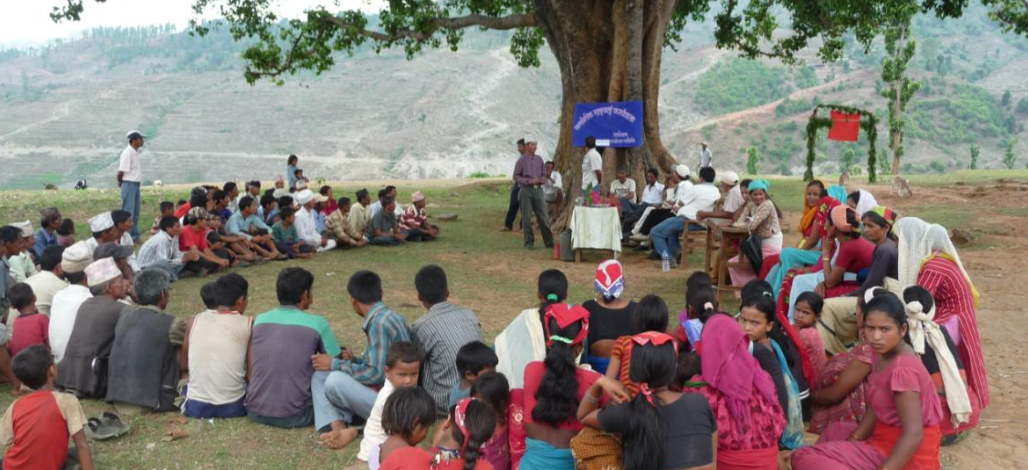
The Beneficiary Assessment approach is focused on gaining insights into community perspectives through interviews and group discussions at community level, by working with members of similar communities (peers) as primary field researchers.
The term Beneficiary Assessment was coined in the 1990s to refer to a participatory project assessment approach developed at the World Bank. Today, this terminology is somewhat outdated as the implication of «beneficiaries» is of passive recipients, whereas the relationship is in fact an active, two-way one. Thus, people participating in a project are more accurately considered to be clients or stakeholders who have both rights – human rights – and duties/commitments as project participants. Nevertheless, the terminology is retained as BA is a well-known and accepted methodology.
The SDC intends to apply BA in the monitoring and evaluation of its projects and programmes, particularly as a means of providing important insights into poverty dynamics. This section of the website provides a variety of materials on the subject, ranging from descriptions of the overall approach, to specific tools and guidelines, to published results of BAs of various projects. The goal is to share learning amongst practitioners as well as to make BAs more accessible to those with an interest in exploring more participatory approaches for project and programme assessments.
Project monitoring and evaluation most often focuses on quantitative aspects of project delivery. Yet what do the people on the receiving end of project interventions – the primary stakeholders – think themselves about it? Did they think it was appropriate, was it implemented in the way they expected, are they satisfied with the results, what would they suggest to do better next time? Hard facts and figures are important, but they are much more meaningful when combined with qualitative and participatory assessments provided by the people who are most directly affected.
Why a Beneficiary Assessment and its Principles
Beneficiary Assessment is about getting people's own perspectives on development results in a fair way and to use the findings to adapt and steer our (Swiss funded, donor) contribution to development processes. It should help us get a better idea of how a project has contributed to its original goals, but it goes beyond this as it gives the range of development actors (donors, implementers, local stakeholders) greater insight into community perspectives on a project's effectiveness and provides a basis for meaningful response to people's self-expressed needs.
For the SDC, the BA is embedded in our results-based management thinking and is one source of information to get insight at the outcome level. It allows verifying the impact hypothesis and checking if the poverty reduction effect implicitly included in a systemic approach is taking place or not.
A BA also serves to bring concerned communities closer to a project: not only are members of communities themselves involved in conducting BA field research, but the community members whose opinions are sought also develop a better idea of what a project is trying to achieve and who is involved in trying to make it happen.
BA is driven by a core set of principles which are designed to ensure that it reaches the goals of revealing local perspectives on development interventions and providing clear indications of how development actors can make meaningful adjustments to their work. These principles are:
Participation and ownership – A crucial aspect of the BA approach is that it creates space for participation by the involved stakeholders, in the design, implementation and interpretation of results. This goes hand-in-hand with a stronger sense of ownership in the process and results.
Inclusion – A BA is aimed at gathering a full range of perspectives of those affected by a project, so it must be designed in an inclusive way, especially for poor and marginalised groups, whose voices are often excluded from mainstream development initiatives.
Representativeness – The process needs to ensure that sampling methods result in coverage of local populations that gives an accurate picture of the project landscape and the people within it.
Differentiation – Another important element of the BA approach is the clear surfacing of different perspectives (through sex disaggregation, disaggregation based on social group).
Self critical quality of analysis – No assessment is unbiased, including a BA. However, conscious effort to explore the implications of the perspectives of various participants (both those being assessed and those doing the assessment), as well as critical reflection on the methodological approach itself, can strengthen BA results.
Responsiveness – A distinguishing and essential principle of a BA is the orientation to using the results to inform future action. If implementer and donors are not prepared to (possibly substantially) adjust what they are doing in response to a BA, the exercise should not be conducted at all.
Why BA? Here are some video impressions of key players in previous BA exercises:
See Video Reports for additional testimonies from various BA stakeholders below under "BA Reports and Resources".
How to organise a Beneficiary Assessment: Basic Steps and Timing
As with any meaningful learning process, a BA requires careful planning and sufficient time (normally 6-8 months from initial planning to final report). This does not have to be overwhelming, however. It is mostly a matter of following a set of seven basic steps, summarised below. Templates for various tasks within the steps can be found below under "Tools and Templates"
(7 Steps)
Step 1: Initial Planning
Key Elements
Identify trainer/backstopper and national facilitator
Create process overview BA approach described in inception report (see below for download)
Select BA intervention areas
Select citizen observers
Additional Planning
Trainer & facilitator to be contracted early in process
Inception report includes BA objectives and descriptions of methodology, intervention areas and overall process
Project staff provide key information and contacts for intervention areas
COs and key local stakeholder groups, including project implementer, are invited
Donor is invited
Indicative Timeline
7 months
Step 6: Reporting and Distribution
Key Elements
Facilitator finalises report
Donor, other core stakeholders distribute report
Additional media/events for reflection on results
Additional Planning
Post-validation workshop report commented on by trainer/backstopper, donor and implementer
Final version of report produced, provided to relevant stakeholders and published
Indicative Timeline
7-8 months
Step 7: BA follow-up
Key Elements
Implementer and donor reflect on implications of BA and take relevant action
Additional Planning
Perhaps one of the most difficult steps, as project or programme cycle may not create opening for adjustment, but of high importance to give BA meaning
Indicative Timeline
8-12 months
As a BA is intended to both provide insight into project impact and feed into future planning, the two most important timing issues are that a project (or potentially a programme):
1) Is sufficiently far into its implementation that possible outcomes can be expected to be visible, and
2) is at a stage where followup action is part of the agenda (e.g. around the time of an end of phase report, a mid-term review or other planned evaluation exercise)
As with most research exercises, it is sometimes necessary or useful to adapt the methodological approach to suit local circumstances. In addition, and depending on levels of experience and complexity of task, it is highly recommended to consider the following possible BA elements:
Engagement of a co-facilitator as well as a facilitator to allow for more intensive field research over the same time period as well as greater research efficiency
Inclusion of a pair of extra citizen observers in the CO training workshop, to allow for possible dropping out/deselection during training, or absence during the field research period due to illness or family emergency
Use of visual methods for training in the case of COs with low literacy levels
Use of video to illustrate good practice and areas for improvement in training exercises
Use of photos/video/stories from households collected during field research to enhance readability and accessibility of the BA report
Here you will find a variety of resources to help you plan and implement a BA. They cover initial planning (inception report, budgeting, terms of reference for facilitators and co-facilitators, roles and responsibilities, process description) as well as early stages of implementation (field testing, facilitator and co-training). Some also cover the overall process of a BA (How-to Note). The templates are in Microsoft Word format for ease of adaptation to your own BA context.
The later stages of a BA (e.g. the field research, validation workshop and reporting) will need to be designed for each specific BA context, but the tools and templates should give you a good foundation on which to build these aspects.
A growing number of Beneficiary Assessments are being conducted around the world. Here you will find:
Selected BA reports from different projects
Video testimonies from specific BA experiences
Reflections on and descriptions of the BA approach
Reports and inputs from BA Learning Events
Together with the other parts of the BA Pack, they should give you all the background information you need to plan and implement a Beneficiary Assessment in your own project or programme context.